Julie and Russell’s domestic altercation and separation
Straight ManJulie Devereaux’s domestic altercation with Russell becomes a separation shaped by competing accounts, her father’s hesitation, and a later message that makes the story less certain without undoing her request for help. The episode moves from a direct disclosure in the family home to a delayed qualification delivered by answering machine, leaving both the cause of the altercation and Julie’s own understanding of it unsettled.
Background and the First Disclosure
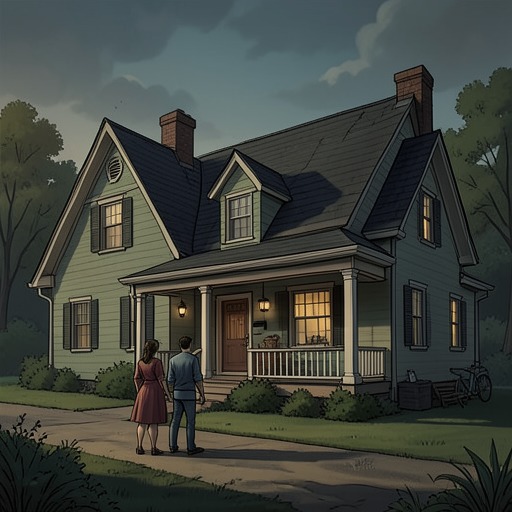
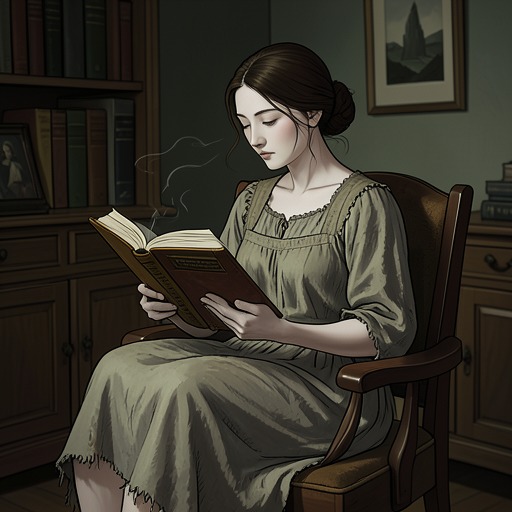
When William Henry Devereaux, Jr. arrives at Julie’s home, she is sitting apart on the long sofa, still in her bathrobe in the early afternoon. She does not greet him or turn toward him. Outside the patio door, wasps hover near a dried nest attached to the eave, a domestic detail that becomes a quiet counterpoint to the crisis inside. Julie’s left eye, the same one she injured as a child, is visibly swollen. Her stillness and the visible sign of a recent incident make the scene legible before she explains what has happened, but they do not establish the full circumstances.
Julie’s first practical statement is that she wants Russell out of the house. Her father asks whether Russell caused her injury and, after she initially says that she fell, asks more directly whether Russell hit her. Julie eventually tells him that Russell shoved her and that she fell. The account unfolds in pauses rather than as a continuous explanation: she takes time to answer, and her father repeats his question instead of moving immediately to what should be done. The scene thus places the request for separation beside an incomplete account of the altercation.
Hesitation and the Decision to Leave
William Henry Devereaux, Jr. does not arrive at the disclosure without reservations. He has always liked Russell and has sometimes taken Russell’s side in disagreements with Julie. He recognizes that he wants to keep asking questions until he can rule out an accident or misunderstanding, and he suspects Julie sees that impulse as disloyalty. The conflict is not only between Julie and Russell; it also tests whether her father can respond to her immediate request without first resolving every uncertainty in her account.
Julie makes her demand again, emphasizing that she wants Russell gone from her house. Her father accepts the practical next step: she can stay at his and Lily’s home for a day or two and should get dressed and pack a suitcase. He cannot finish explaining what they will be waiting for, because Russell’s return, Lily’s return, or some other resolution remains uncertain. His offer provides a place to go without pretending that the longer-term arrangement is settled.
Julie does not object. When she stands, she and her father embrace, and she sobs while calling him Daddy repeatedly. The speed of the movement unsettles his sense of who approached whom; what matters is that the hesitation gives way to physical comfort and action. She packs some belongings, and the two leave together. Her departure converts the request that Russell leave into an immediate separation between Julie and Russell, while leaving the status of their home and relationship unresolved.
The Later Message
The account changes when Julie contacts her father later by answering machine. After mentioning that she will return after dealing with a locksmith, she begins speaking about Russell in a more intimate and uncertain register. She says that the incident is not entirely his fault and revises the earlier description: he did not, in her later phrasing, shove her exactly. She also says that something has felt wrong with her for a long time, but the message breaks off before she can complete the thought.
This later account does not simply replace the first one with a definitive alternative. In the living room, Julie had described Russell pushing her and causing her fall; in the message, she qualifies that account and asks her father not to blame Russell. The change leaves the reader with a genuine tension between two statements from Julie, rather than resolving the event into a single uncontested version. The message supplies no further explanation of what she means by feeling that something is wrong, so the source and significance of that self-assessment remain unspecified.
The answering machine cuts Julie off, and she continues only after the device has stopped. Her father is standing at the counter with a hand on the phone, but he does not pick up the receiver. He says her name without connecting to the call. The missed exchange makes the qualification arrive as a recorded message rather than a conversation in which he could ask what she means or hear her complete the thought. Julie says she will talk to him later, but the episode offers no resolution in that moment.
Family Witness and Narrative Significance
At the original encounter, William Henry Devereaux, Jr. thinks that Lily is missing from the situation—not simply because he needs advice, but because he relies on her to help him know how to feel and which emotions are valid. Her absence sharpens his difficulty: he must answer Julie without the interpretive reassurance he associates with his wife. His eventual offer of shelter is therefore a concrete response made amid uncertainty, not the result of having settled the facts.
The wasps and their nest frame the episode without explaining it. Julie’s observation that they do not learn accompanies her wounded appearance, and her father watches them again while she packs. The dried nest remains attached to the eave as they prepare to leave, an image of a home whose familiar form offers no guarantee of safety or permanence. Later, in the kitchen, the answering-machine exchange ends with William Henry Devereaux, Jr. looking through a window at spring foliage that obscures the neighboring development. The scene closes not with a verdict about Russell, but with Julie’s request that he not be blamed and her father left holding an unanswered call. Together, the departure and the later qualification make the separation both necessary in the immediate moment and emotionally unresolved.